Top tips for baby skin care

I’m a parent, what can I do to help my child with a dry skin condition?

You should always consult your GP or health visitor if you have any concerns about the health of your baby or child or think they may have a dry skin condition.

In the UK, eczema affects up to 20% of children and up to 3% of adults.1 Psoriasis affects between 2% and 3% of the UK population (an estimate of up to 1.8 million people).2


How do I know if my baby or child has a dry skin condition?

Babies often get red, scaly skin known as eczema. The symptoms are patches of red, dry and itchy skin on the face or behind the ears, and in the creases of the neck knees and elbows.3 With psoriasis, there may be plaques on the skin that are red, itchy and sore, with white or silvery scales.2,4 These patches are normally across elbows, knees, scalp and lower back, but can appear anywhere on the body.2,4
How can I help to soothe the dry skin condition?

Remember to consult a doctor or health care professional for advice on the treatment and management of your child’s skin condition. We’ve collated some information from the NHS below that may help:

Eczema3

  • Apply an unperfumed moisturiser (also known as an emollient) to the affected areas by smoothing into the skin several times a day for example, when you feed or change your baby to keep the skin hydrated
  • Avoid using soap, baby bath and bubble bath as these can dry or irritate the skin. Instead use a soap substitute or soap-free wash that will help to keep the skin moisturised and won’t strip the skin’s natural barrier
  • Try to keep your child’s bedroom as cool as possible, as if they get hot then this can make their eczema worse
  • Try to identify and avoid anything that may be irritating their skin, such as soap powder, animals and chemical sprays


Psoriasis4

  • There are many different treatments available for psoriasis, so it’s best to speak with your doctor about the right one for your baby
  • Keep the skin comfortable by using an emollient to regularly moisturise it
  • Psoriasis is a long-term condition, so it’s best to try and identify triggers to be able to avoid them.


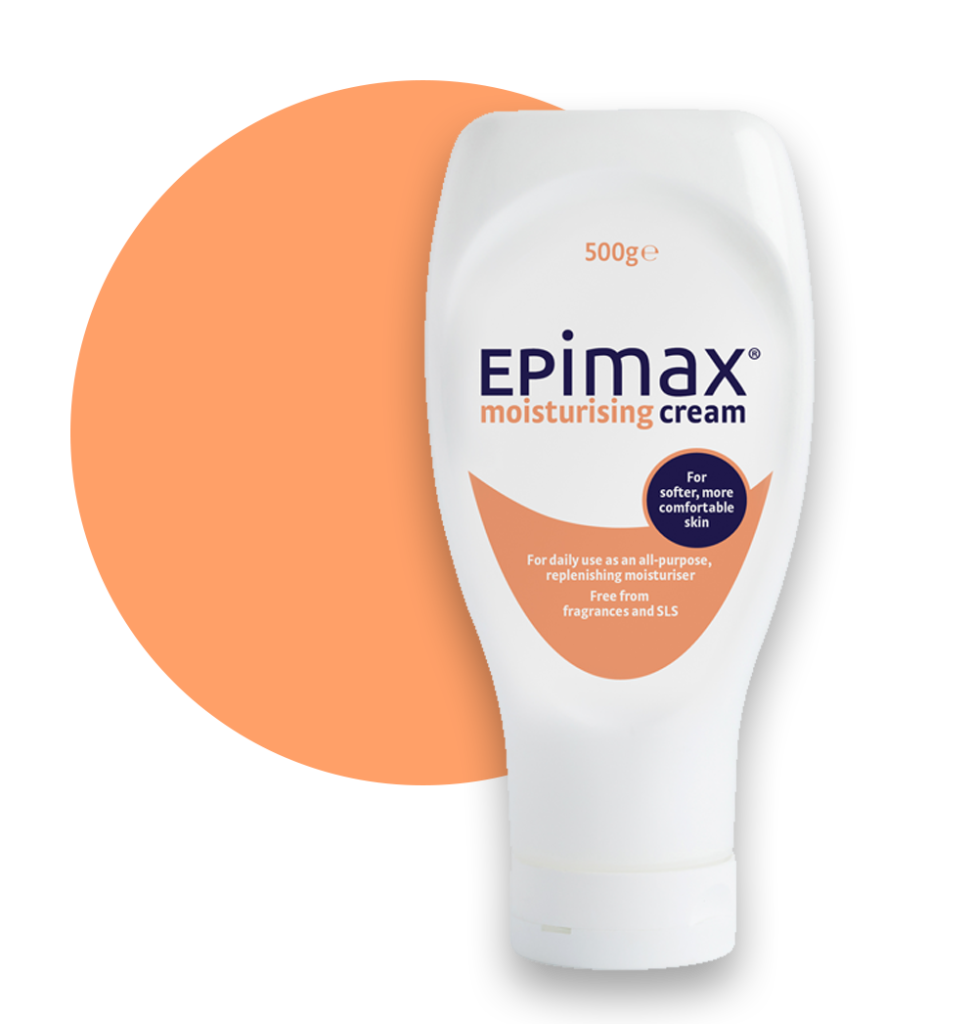
EPIMAX® Moisturising Cream is suitable for use by the whole family, including children over the age of one month. The rest of the EPIMAX® range is suitable for all ages.

MAT-UK-EPI-0058-1 | November 2025
Dry skin in Winter

In this article, we will be looking at what it is like to have dry skin, or a dry skin condition in the winter months. For people with eczema and psoriasis, winter can be a challenging time to manage symptoms and prevent flare-ups.1,2

Skin can become dry, red and irritated by things like a drop in temperature, central heating, wind, and low humidity.3 Cold air and low humidity can strip moisture from the skin, this reduces the naturally occurring oil known as sebum, which acts as a protective layer and traps moisture next to the skin.4,5 If the skin doesn’t have enough sebum, it can lose water and feel more dry.4 Problematic areas of the body include the hands and face, which are most exposed to the elements.1

These seasonal changes can be enough to cause increased flare-ups for those with dry skin conditions.1 Read our tips about the things you can do during this time to help minimize flare-ups and keep your skin as comfortable as possible:

As with any emollient, always read the label. 

Listen to your skin and adapt your routine
Depending on your skin’s needs you may need to:

  • Apply your emollient more regularly to keep your skin moisturised and your symptoms in check
  • We’d recommend using a soap-free body wash, like EPIMAX® Gentle Wash (all year round) to help protect your skin’s natural, protective barrier. Our formula contains glycerin to help maintain skin hydration while washing, leaving it feeling soft.
  • Consider adding a new product into your usual routine that may deliver a bigger hydration boost, like a gel or ointment if you usually use a cream formulation


Tips to help manage your symptoms

  • Wear gloves when you are outside to help protect your hands from the cold1
  • Many people with eczema or psoriasis find that wool and synthetic materials (commonly used in winter hats, scarfs, and gloves) cause overheating, sweating and irritation. Instead, we suggest you look for soft, seam-free fabric alternatives, such as cotton, bamboo or silk.1,2 Alternatively, wearing a soft layer between your skin and irritating materials can also help to protect your skin.
  • Turn the heating down when you are indoors and put on extra layers of clothing. Opting for multiple ‘thin’ layers is good as means you can have more control of your temperature3
  • Limit your exposure to hot and dry environments like air-conditioned rooms or cars, or rooms containing open fires or wood burning stoves as they can further dry out the skin1,2
  • Drink plenty of water during the day to help keep your skin hydrated2
  • Avoid taking hot baths and showers as hot water strips the natural oils from the skin2

Everyone’s skin is different, which means that the product that works for you is unique to you. It’s important that you find a product that works for you, your symptoms and that fits around your lifestyle. Visit our product page to find a winter skincare moisturiser.

  1. https://eczema.org/information-and-advice/triggers-for-eczema/weather-and-eczema/ (Accessed November 2025) 
  2. https://www.psoriasis-association.org.uk/news/cold-weather-tips (Accessed November 2025) 
  3. Living-with-Eczema-info-for-adults-2023.pdf (Accessed November 2025) 
  4. https://www.health.harvard.edu/a_to_z/dry-skin-a-to-z  (Accessed November 2025) 
  5. Dr Amanda Oakley Dermatologist & Vanessa Ngan, ‘Sebum’ Dermatology Education New Zealand, 2014 http://www.dermnetnz.org/topics/sebum/ (Accessed November 2025) 

MAT-UK-EPI-0057-1 | November 2025

EPIMAX® Moisturising Cream (HCP)

We'd recommend EPIMAX® Moisturising Cream for your patient...

Comfort

For softer, more comfortable skin

Contains lanolin to help hydrate dry skin.

Why we think your patient might like EPIMAX Moisturising Cream...

Your patient might also like to try...

If your patient needs a shower gel alternative:

Cleanse / soften