Emollients are moisturising treatments applied directly to the skin to soothe and hydrate it; they cover the skin with a protective film to trap in moisture.1
Once you’ve found an emollient that works for you, your skincare needs and your lifestyle, it’s good to understand how you can keep your skin feeling comfortable and prevent flare-ups.
It’s important to find a routine that works for you, to keep your dry skin symptoms at bay. Emollients will give your skin a boost of moisture whenever your skin begins to feel dry.1
When applying any emollient, always read the label and avoid contact with eyes.
How to apply
Smooth your preferred emollient into your skin, in the direction of hair growth, being careful not to rub your skin. (This prevents your hair follicles from getting blocked)1
Use a clean spoon or spatula to remove emollients from a pot or tub, to reduce the risk of bacteria contaminating the tub1
Care should be taken when applying emollients to the face. EPIMAX® Ointment and EPIMAX® Paraffin-Free Ointment shouldn’t be used on the face and wash hands after use. Instead, look for an emollient specifically formulated for delicate areas such as the eyelids.
How much to apply
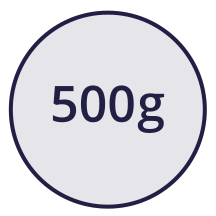
Apply in adequate quantities. Emollient guidelines state that the weekly recommended amount to use to treat a large area of the body in diagnosed dermatological skin conditions, such as eczema and psoriasis, is at least:
500g a week for an adult2
250g a week for a baby or small child2
How often to apply
Emollients should be applied as often as you need to keep your skin moisturised and comfortable
Apply liberally and frequently, ideally, this should be at least three or four times a day1
Hands are often exposed to the elements so they may require application more often to keep them well moisturised
Creams Ideally, apply every 3-4 hours2
Gels Ideally, apply 3 to 4 times a day2
Ointments Ideally, apply every 6-8 hours2
When to apply
Best applied after washing your hands, taking a bath or showering because this is when the skin needs the most moisture1. Pat your skin dry with a towel, avoiding rubbing it. Then apply your emollient once your skin is dry to make sure that it is properly absorbed.
Body wash and/or bath additives
Mix a small amount of your emollient (around a teaspoonful) in the palm of your hand with a little warm water and spread it over damp or dry skin
Afterwards, rinse and gently pat the skin dry, being careful not to rub it. Most emollients (when used as body-wash alternatives or bath additives) don’t foam like soap does, but are still as effective at cleansing the skin1
If you are using your emollient as a body wash or bath additive, take extra care in the bath, shower or on a tiled floor, not to slip
Protect the floor with a non-slip matt, or towel. After you’ve finished wash your bath or shower with hot water and washing up liquid to remove any residue left by your emollient
Prefer a Foaming Cleanser? Soap-free foaming body washes are also available. These differ from using an emollient body wash alternative as they produce a gentle lather, while still being kind to sensitive or dry skin
If you are using your emollient as a body wash or bath additive, take extra care in the bath, shower or on a tiled floor, not to slip